The Severn Cross Roads Foundation, Inc.
Severn Cross Roads Foundation, Inc. is a not-for-profit Section 501 (c) (3) tax-exempt organization that was formed under Maryland law in the 1970's for the purpose of moving and preserving the Charles W. Baldwin Hall. Since the building was moved to its present location in the 1980's the Foundation has actively restored and maintained Baldwin Hall, the 1840's replica Schoolhouse, and the surrounding grounds, for use as a community center.
The Severn Cross Roads Foundation affirms inclusion as a means toward the essential ends of historic preservation, community service and involvement: equalizing opportunity, providing preservation of historic experiences for all sectors of society, and enriching the experience of all members of the Severn Cross Roads and broader community. SCRF is committed to exploring and implementing initiatives that support efforts to achieve a community-preservation-based educational and use environment that is open and welcoming to all. Severn Cross Roads Foundation, Inc. does not and shall not discriminate on the basis of race, color, religion (creed), gender, gender expression, age, national origin (ancestry), disability, marital status, sexual orientation, or military status, in any of its activities or operations. These activities include, but are not limited to: admission of members, hiring and firing of contractors, selection of volunteers and vendors, and provision of services. Within our budgetary means, we strive to attract a diverse community of trustees, members, and users, to provide an accessible and meaningful historic interaction and enjoyable environment for user events, and to improve our local community through thoughtful programming and activities that invite inclusive interaction.
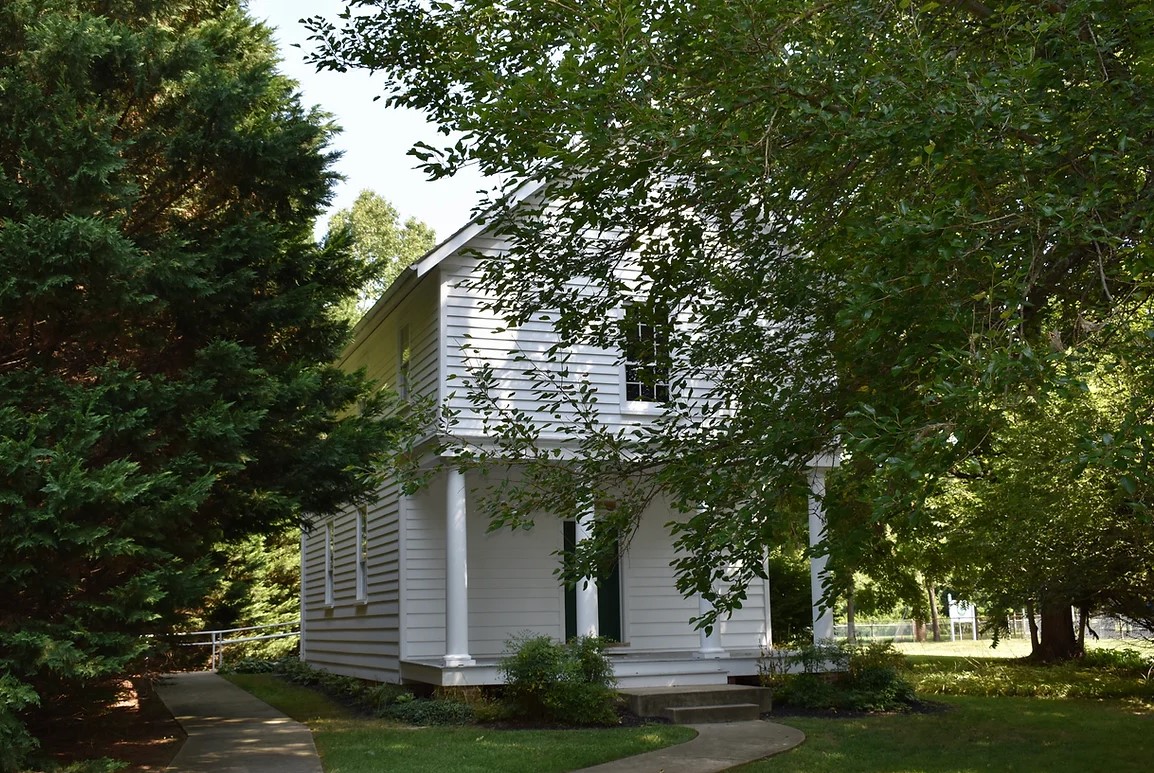
Charles Winterfield Baldwin Hall
The Old Cross Roads Church was built by the Methodist Society in 1861. About 1896 the "crossroads church" was moved across Indian Landing Road to make way for the building of the Baldwin Memorial Church. in 1935, the building was rededicated in honor of the Rev. Charles W. Baldwin, a former pastor who served the Methodist ministry for over 70 years. The old church was used as the church school and parish hall until about 1970. Over much debate to destroy the old church hall in favor of a larger facility, several local members tirelessly worked to raise funds and organize for the hall to be saved and moved once more. The church hall was then moved across Generals Highway to its current location.
Listed on the National Register of Historic Buildings, Baldwin Hall is a significant example of country church architecture because it is a combination of the popular mid-19th century "Carpenter's Gothic" detailing applied to a much earlier form. The molded battens, tiny arches, louvered vent and shutters are creative and well executed embellishments on an 18th century church plan.

Who Was Charles W. Baldwin?

Many people are familiar with Anne Arundel County’s Historic Baldwin Hall (1861) on Millersville Road, but not everyone knows about the man for whom it is named, Rev. Charles Winterfield Baldwin. He was a remarkable man, and his story deserves to be told.
Charles Winterfield Baldwin was born 23 March 1840, the tenth of eleven children of Judge William Henry Baldwin and Jane Maria Woodward, the grandson of Captain Henry Baldwin who served in the Revolutionary War. He and his siblings grew up at the family home, Bunker Hill, in Anne Arundel County, near the site of the present Baldwin Hall.
After studying at local schools, Baldwin entered Yale University in 1859 as a junior, graduating in 1861. While at Yale, he was also secretary of the Yale baseball team. (Go, Bulldogs!) After graduation, he studied law in Baltimore for two years, but ultimately decided to enter the ministry, studying at Yale Divinity School and Union Theological Seminary.
In 1866, he began his ministry as a junior pastor on the Severn Circuit, which included his family home as well as the Cross Roads Church, now Baldwin Memorial United Methodist Church. By 1897, he was the presiding elder of the West Baltimore District of the Methodist Episcopal Church and was superintendent of the Baltimore City Mission until 1910. He retired from the ministry in 1916, but often returned to the pulpit, frequently recalling the "old-time Methodist experience" which he hoped would revive.
Rev. Baldwin was raised in the years that led up to the Civil War, and his family owned slaves. But, as early adherents of John Wesley’s Methodism, they were challenged to reflect on the morality of slave ownership. That reflection led to slaves being freed before the Civil War and given land to help them build a life of freedom.
Rev. Baldwin was committed to living a life that recognized the inherent value of all human beings and devoted his energy to creating opportunities for women and black people, especially in education. In 1884 he was an incorporator of the Women’s College of Baltimore City (now Goucher College) and served as a trustee. He also helped to found, and later served as Chancellor of, American University, an institution that educated men and women, black and white, for careers in public service. Starting in 1899, he served 24 years as a trustee of Morgan State College (now Morgan State University), an historically black institution in Baltimore.
Rev. Baldwin married Annie Campbell Hopkins in 1868 and had a daughter Marie with her. After Annie’s death, he married Anna Thomas in 1876. There were no children from his second marriage.
In the years before his death, Rev. Baldwin lost his sight but had the newspaper read to him every day. He died in Baltimore MD in 1938 at the age of 98, the last surviving member of his graduating class at Yale, having served 70 years in the Methodist ministry.
He is buried in the cemetery at Baldwin Memorial United Methodist Church in Millersville MD, just down the road from the house where he was born and across the street from the 1861 hall that bears his name.
The Cora Anderson Dulaney Library next to Historic Baldwin Hall has a large collection of Rev. Baldwin's letters and papers.
1840's Replica Schoolhouse

In 1999-2000, the Foundation was able to reconstruct a replica of the 1840's schoolhouse that once stood next to Baldwin Hall. The second floor of the schoolhouse houses the Cora Anderson Dulaney History Library. The schoolhouse is available for tours. The History Library is open by appointment.